


What Makes a Leather Belt Last?
Inside the design and construction of the Barossa Belt
A leather belt lasts when its materials, construction and finishing are chosen not only to withstand years of everyday wear, but also to age well together. Failure of the leather or hardware can end its useful life, but a belt may also be discarded long before it stops functioning because coatings peel, leather cracks or plating wears through. Longevity comes from how all those decisions work together, and whether the belt can be maintained as it changes through use.
I spent 23 years as a Process Development Scientist in the pharmaceutical industry, designing manufacturing processes for biological medicines. It is precise work where understanding exactly why something is done a certain way is not optional. Every material choice and every process step has a purpose; together, they must ensure the medicine can be produced consistently and meets stringent standards for quality, safety and efficacy. Cost and efficiency matter, but never at the cost of quality.
When I left the industry to make leather goods full time, I brought the same way of thinking with me. I had always been interested in quality, not just as an aesthetic, but as a series of design and engineering questions. What actually makes one object better than another? How well does it fulfil its intended function? What determines whether it lasts for decades or falls apart after a few years? Is it straightforward to use and maintain? Does it remain enjoyable to own as it ages?
Durability is an important part of quality, but it is not the whole of it. A well made object should perform its function properly, withstand regular use and continue to merit its place in its owner's life as it ages. The decisions that determine those qualities are made at the bench, often in details not immediately visible.
The leather
Bridle leather has a long history in the English saddlery tradition. It is vegetable tanned using plant-derived tannins, rather than the chromium salts used to produce most modern leather. Vegetable-tanned leathers are often described as having the character of wearing in, not wearing out. They get better with age as they become more pliable and pick up marks and patina, as opposed to looking perfect on day one and deteriorating from there. After tanning, it is dressed with tallow and waxes, which are worked into the leather by hand to create its characteristic strength, suppleness and waxy finish.
It is a slow process. The leather I use for the Barossa Belt takes around thirteen months to produce from start to finish. It cannot be meaningfully rushed without changing the resulting material. Only a small number of English tanneries continue to make bridle leather using these traditional methods and they are quite unique in character and appearance.
Other bridle leathers do exist and the term ‘English bridle leather’ is also sometimes used to describe a style of leather made outside England. Some of these leathers are good materials in their own right, but they are not necessarily produced using the same lengthy tanning and hand-dressing methods.
In my experience, the difference is readily apparent. Traditionally made English bridle leather has a smoother surface, a more supple but substantial feel and a deep wax dressing that runs through the leather. Those differences also influence how it stretches, wears and develops over time.
Origin alone is not what makes a leather good. What matters is the process behind it, the integrity with which it is made and whether its particular character suits the intended design. I often use an Australian-made bridle leather and it is excellent leather, but it has a distinctly different feel and finish from traditionally made English bridle leather. For this version of the Barossa Belt, I chose English bridle leather from Thomas Ware & Sons because its smooth surface, supple but substantial handle and deep wax dressing give the belt the weight, durability and refined character I wanted.
I cut each strap from the butt section of the hide. This is the firmest and most consistent section of the hide, with the densest fibre structure. That density helps the finished belt resist stretching through years of regular wear. I buy full bridle butts, not pre-cut straps, so I can control exactly what goes into each belt.
The stitching
I trained in traditional saddle stitching with Nigel Armitage in England. It is the stitching method I use for the Barossa Belt, and the reasons are practical rather than sentimental.
A saddle stitch is worked by hand with two needles and a single length of thread, one needle passing through each hole from either side. This creates two opposing thread paths through the leather, with each stitch individually locked in place.
A machine lockstitch instead interlocks a needle thread with a separate bobbin thread between the layers of leather. If either thread breaks, the adjacent stitches can lose their restraint and the seam may progressively open. With a properly formed saddle stitch, damage at one point is more likely to remain contained, while the opposing thread path continues to help hold the seam together.
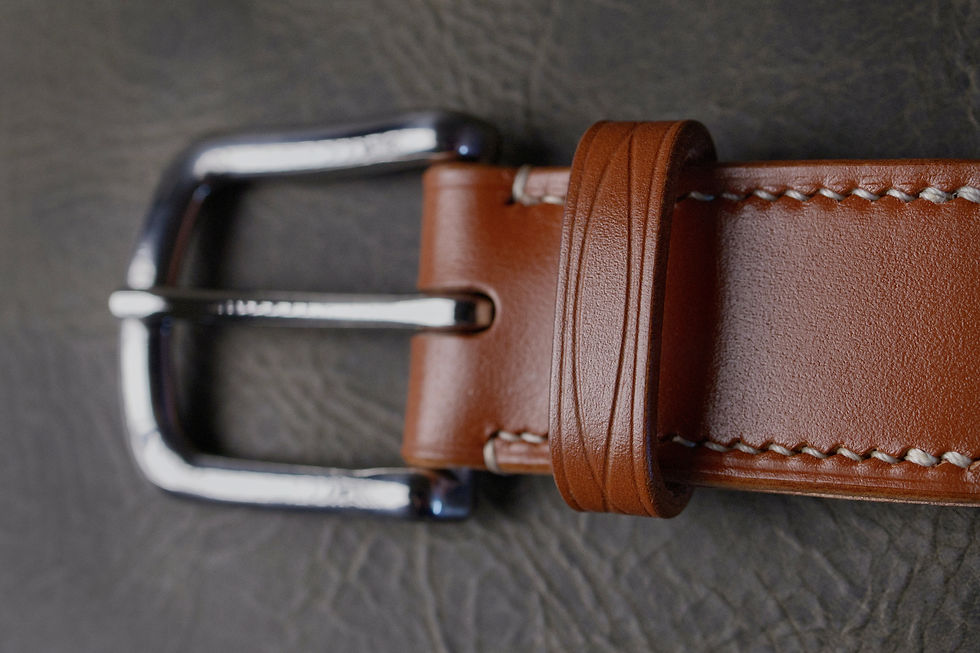
The direction of the stitching at the buckle is another deliberate detail. On the Barossa Belt, the seam runs along the length of the belt rather than across it.
A transverse seam, across the belt, creates a narrow line around which the leather moves. Over time, that movement will produce a small see-saw action, placing repeated stress on the thread and the leather surrounding the stitch holes. The leather can then stretch and the thread is more likely to fail. Running the stitching longitudinally greatly reduces that movement, giving a much more stable seam. It's why traditional saddlery has long used that method for straps and bridles.
The keeper, the leather loop that holds the loose end of the belt, is stitched into position rather than left floating. This prevents it from moving freely along the belt or being easily lost. This is another reason machine-stitched belts are usually stitched across the belt. A sewing machine can't easily stitch along the belt and negotiate stitching the keeper in place as it gets in the way of the sewing machine foot.
Both sides of the return (buckle attachment) are sewn with a single length of thread, connected through a saddler’s twist at the fold. This creates one continuous thread length with only one start point and one finish point. It is a clean and efficient construction and ultimately more secure. The stitching can also be easily undone and re-stitched several times in order to change the buckle if so desired.
The buckle
The buckle is made from solid stainless steel. The choice is primarily structural.
Many mass-produced buckles are pressure die-cast from zinc-based alloys because these materials are economical and can be formed efficiently into complex shapes. A well-designed zinc-alloy buckle can perform adequately, but the quality of the alloy, casting and buckle design varies considerably. Thin sections or poor-quality castings can create weak points that fracture under impact or repeated loading.
Replacing a failed buckle on an otherwise sound belt is one of the most common repairs I undertake in the workshop. Most of the failed buckles I see are made from zinc alloy. They may look substantial and well finished when new, but have fractured after only a few years of use.
Stainless steel combines strength with excellent toughness and corrosion resistance. It is much more tolerant of the knocks, pulling forces and changing conditions an everyday belt encounters. That makes it a material I am comfortable relying on for a belt intended to remain in service for many years. I generally recommend solid stainless steel and solid brass for belt buckles and most other leather hardware. Several other reliable options do exist; bronze and several precious metals can also work well.
The unplated finish is a secondary benefit. Because the buckle is solid stainless steel, there is no decorative surface layer to wear through and expose a different metal beneath. Its restrained appearance also suits the character of the Barossa Belt, allowing the leather and construction to remain the focus.
The belt holes
Even the belt holes have been considered.
I use a 6mm round punch, slightly larger than is typical, but it works well with this weight of leather and allows the buckle prong to pass through cleanly without having to be forced against the sides of the opening.
An oval hole would also work at this size, but I prefer the appearance of a round hole. It is simpler, cleaner and less industrial. It is a small detail, but an intentional one.
The edges
Edge finishing is one of the places where the long-term difference between construction methods becomes particularly visible. Some use modern edge paints, some use the more traditional method of burnishing to round and seal the edge fibres, and some just leave the edges raw.
Edge paint is not inherently a poor finish. When carefully applied, it can create a very clean and refined appearance. Good modern edge paints are very durable. They are, however, surface coatings and can be expected to deteriorate eventually. On an object such as a belt, which is repeatedly flexed and subjected to abrasion, a coated edge is more likely to crack, separate or peel. Renewing it requires removing and rebuilding the applied finish.
The edges of the Barossa Belt are creased with a creasing iron heated over an open flame, this gives a finished look to the belt and also offers some protection by preventing water frtom wicking in through the edge and creating water marks on the leather. Then the cut edges are burnished by hand using a traditional process. Water and a wooden slicker are used to compress and smooth the exposed leather fibres before the edge is sealed and protected with a wax blend. The resulting edge ages with the leather rather than separately from it. It may acquire marks and character through use, but there is no layer of paint to peel away. It can also be cleaned, re-waxed and re-burnished as part of the belt’s future care.
Why the Barossa?
Gibson Handcraft is based in Willaston, just outside the Barossa Valley in South Australia.
The name felt right for what I was trying to make: an Australian-made belt with the refinement and seriousness that the Barossa’s winemakers have long understood. Provenance matters. Process matters. Materials matter. The best things take the time they take.
The Barossa Belt is built this way because these are the materials and methods I can stand behind honestly. Every component and every process step has been selected for a reason. No material or construction method was chosen simply because it was cheaper or faster.
It is not intended to be a disposable accessory. It is an everyday object made to be used, maintained and allowed to develop character over many years.
The Barossa Belt is made to order in my Willaston workshop, sized for its owner and available in a considered selection of leather colours and stitching options.

Comments